Professional Headshot Trends 2026: What's In and What's Out?
Your professional headshot is more than just a profile picture. It is part of your personal brand.
Whether someone discovers you on LinkedIn, visits your company website, reads your online portfolio, or receives your business email, your photo helps shape their first impression.
But professional photography is changing.
The stiff corporate portraits, overly polished skin, and generic white backgrounds that once dominated business profiles are gradually giving way to a more natural and personal style. In 2026, professionals want headshots that look confident, approachable, and authentic.
AI headshot generators are also changing how people create professional portraits. Instead of arranging a traditional studio session, you can now explore different professional styles using your own photos.
So, what are the biggest professional headshot trends in 2026? Which styles are worth trying, and which outdated looks should you leave behind?
Let's take a closer look.
1. The Biggest Professional Headshot Trends in 2026
The overall direction of professional headshot photography in 2026 can be summed up in three words:
Natural. Modern. Authentic.
A professional portrait should still look polished, but it no longer needs to feel overly formal or heavily edited.
Here are the key trends shaping professional headshots this year.
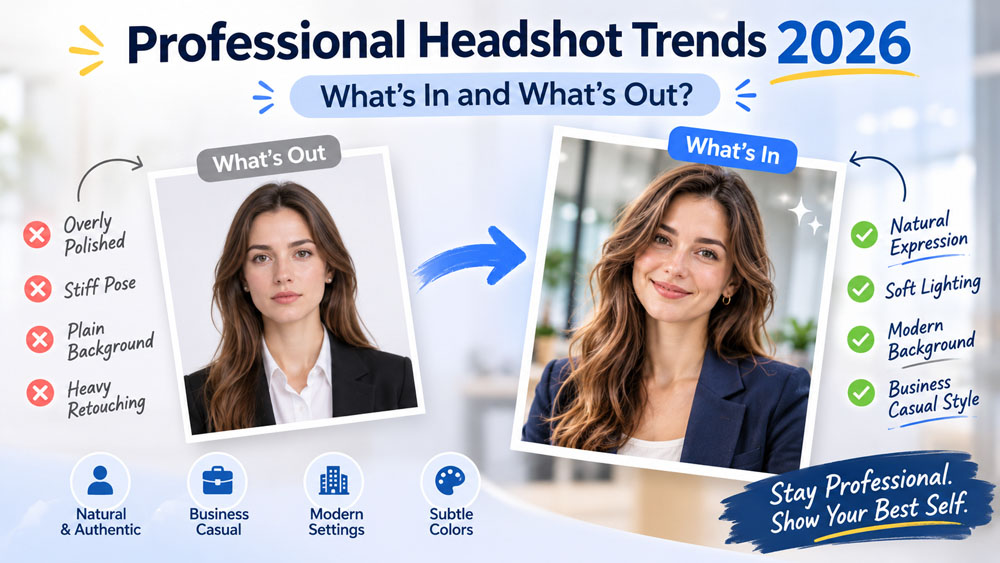
Trend 1: Natural Expressions Instead of Stiff Poses
What's in: Relaxed expressions, genuine smiles, natural eye contact, and comfortable body language.
What's out: Forced smiles, rigid shoulders, and the classic corporate pose that makes everyone look the same.
A professional headshot should communicate confidence without making you look uncomfortable.
A slight smile, a relaxed jaw, and a natural head position can make a portrait feel much more approachable.
You don't need to look like you're posing for a magazine cover. The goal is to look like someone people would feel comfortable working with.
This style works particularly well for:
LinkedIn profile photos
Consultants and business professionals
Marketing and sales specialists
Entrepreneurs and startup founders
Customer-facing professionals
Trend 2: Natural Lighting Over Harsh Studio Lighting
What's in: Soft window light, gentle shadows, balanced exposure, and natural-looking highlights.
What's out: Extremely bright flash photography, flat lighting, and unnatural shadows.
Lighting has a major influence on how a professional portrait feels.
Soft, directional light can add depth to your face while keeping your skin looking natural. It also helps create a more relaxed, modern appearance.
You can achieve this look with:
Soft daylight from a nearby window
A well-lit indoor environment
Diffused studio lighting
Gentle outdoor light during overcast conditions
For AI-generated headshots, choose a style that uses realistic lighting rather than dramatic effects or excessive artificial highlights.
Trend 3: Business Casual Is Becoming More Popular
What's in: Blazers, open-collar shirts, simple knitwear, and smart casual outfits.
What's out: Wearing a full formal suit for every professional portrait, regardless of your industry.
Not every professional needs to look like a bank executive.
In technology, marketing, education, and many modern workplaces, business casual clothing can communicate professionalism while keeping your image approachable.
Some popular combinations include:
Navy blazer with a white shirt
Charcoal jacket with a simple top
Neutral knitwear
Open-collar business shirt
Minimalist smart casual clothing
Traditional suits are still appropriate for lawyers, senior executives, finance professionals, and other formal industries. The difference is that formal business attire is no longer the only definition of a professional headshot.
Trend 4: Environmental Backgrounds Instead of Generic Studio Backdrops
What's in: Subtle office environments, modern workspaces, architectural details, and softly blurred real-world settings.
What's out: Distracting backgrounds, unrealistic luxury offices, and generic backgrounds that look disconnected from the person's profession.
A background can communicate something about your working environment and professional identity.
For example:
A modern office can suit business consultants.
A clean workspace can suit technology professionals.
A neutral studio background can suit executives and lawyers.
A subtle creative environment can suit designers and marketing professionals.
The most important rule is that your background should support your portrait, not compete with it.
A softly blurred environment often provides enough context without distracting attention from your face.
Trend 5: Natural Skin Texture Instead of Heavy Retouching
What's in: Subtle image enhancement, realistic skin texture, and natural facial details.
What's out: Plastic-looking skin, excessive smoothing, exaggerated facial changes, and unrealistic perfection.
Professional photography is increasingly moving away from the heavily retouched look.
People want to look polished, but they also want to look like themselves.
This is especially important for AI headshots. Some AI tools may produce portraits with unusually smooth skin, perfectly symmetrical features, or facial details that look artificial.
A good professional headshot should preserve:
Natural skin texture
Realistic facial proportions
Recognizable facial features
Natural hair details
Believable lighting and shadows
The best result is not necessarily the most flawless image. It is the one that looks like you on a particularly good day.
2. What's Out in Professional Headshots in 2026?
Understanding what is becoming outdated can be just as useful as following new trends.
Here are five styles worth reconsidering when updating your professional photo.
1. The Overly Formal Corporate Portrait
A perfectly straight posture, tightly buttoned suit, and serious expression can still work in certain industries.
However, using this style for every profession can make your profile feel unnecessarily stiff.
Try instead: A relaxed business portrait with a blazer, natural expression, and slightly angled shoulders.
2. The Artificially Perfect AI Face
AI-generated portraits sometimes make people look younger, slimmer, or more symmetrical than they really are.
While the results may look attractive, they can create a mismatch between your online appearance and your real-world identity.
Try instead: Use AI to improve lighting, clothing, and background while keeping your actual facial features recognizable.
3. The Distracting Background
Busy office environments, colorful decorations, visible clutter, and unrealistic backgrounds can pull attention away from your face.
Try instead: Choose a clean studio background or a softly blurred professional environment.
4. The Heavy Beauty Filter
Excessive skin smoothing, artificial makeup, and exaggerated facial enhancement can make a professional portrait look less trustworthy.
Try instead: Keep natural details and use only subtle adjustments.
5. The Outdated Selfie
A casual selfie taken in poor lighting, with an awkward crop or distracting background, may not communicate the professional image you want.
Try instead: Use a recent, clear photo with good lighting as the starting point for a professional portrait.
3. The Best Professional Headshot Backgrounds in 2026
Choosing the right background is one of the easiest ways to modernize your professional portrait.
The best option depends on your industry, personality, and intended use.
Here are five popular background styles worth considering.
Clean Neutral Studio Background
Best for:
Corporate employees
Lawyers
Finance professionals
Consultants
Job seekers
A light gray, beige, or soft white background keeps the focus on your face.
This is a reliable option when you need a versatile image for LinkedIn, resumes, business profiles, or company directories.
Modern Office Background
Best for:
Business consultants
Managers
Entrepreneurs
Technology professionals
Sales professionals
A softly blurred office background creates a sense of context without looking too staged.
It works particularly well for professionals who want to communicate experience and approachability.
Dark Charcoal Background
Best for:
Executives
Business owners
Senior consultants
Leadership profiles
Charcoal and darker neutral backgrounds can create a more refined and confident appearance.
Compared with pure black, charcoal often provides a softer, less dramatic look.
Soft Outdoor Background
Best for:
Creative professionals
Coaches
Freelancers
Personal brand creators
Natural greenery, soft daylight, and subtle architectural details can create a friendly and contemporary portrait.
Make sure the background remains understated.
Minimalist Gradient Background
Best for:
LinkedIn profiles
Personal websites
Technology professionals
Modern business profiles
A subtle gradient adds depth while keeping the overall appearance clean.
It is a good alternative to a completely flat background when you want something modern but not distracting.
4. What Should You Wear for a Professional Headshot in 2026?
Your clothing should match your professional identity.
The current direction is toward comfortable, well-fitted clothing that looks professional without appearing unnecessarily formal.
Here are some recommendations by profession.
| Profession | Recommended Clothing | Overall Style |
|---|---|---|
| Finance | Navy or charcoal suit | Formal and trustworthy |
| Lawyer | Tailored blazer or suit | Confident and authoritative |
| Technology | Smart casual shirt or blazer | Modern and approachable |
| Marketing | Business casual clothing | Creative and polished |
| Healthcare | Professional attire or suitable workwear | Friendly and trustworthy |
| Education | Simple blouse, shirt, or blazer | Warm and approachable |
| Entrepreneur | Blazer with a simple top | Confident and contemporary |
| Executive | Tailored business suit | Refined and professional |
Colors That Work Well
Some practical color choices include:
Navy blue: Professional and dependable.
Charcoal gray: Refined and understated.
White: Clean and simple.
Beige: Warm and approachable.
Deep green: Modern and distinctive.
Burgundy: Adds personality without being too bright.
Avoid large logos, overly busy patterns, and clothing that competes with your face.
A simple outfit usually works better in a small profile-photo crop.
5. AI Headshots in 2026: A New Way to Create Professional Photos
One of the biggest changes in professional portrait creation is the growing availability of AI headshot tools.
Previously, getting a professional headshot usually meant finding a photographer, booking a session, choosing an outfit, traveling to a studio, and waiting for edited photos.
AI headshot generators offer another option.
You can start with a suitable selfie and explore different professional looks without arranging a traditional photoshoot.
Why Are More People Exploring AI Headshots?
There are several practical reasons.
Convenience
You can create professional portrait variations online without scheduling a studio appointment.
More style options
You can explore corporate, business casual, executive, creative, and other professional looks.
Background flexibility
Different background styles can help you create portraits for different platforms and purposes.
Lower barriers to getting started
AI tools can be a practical alternative for students, job seekers, freelancers, and small business owners who do not want to invest in a traditional photoshoot.
However, AI does not automatically guarantee a professional result.
The quality of your reference photo, the generation technology, and the style you select all matter.
What Makes a Good AI Professional Headshot?
A good AI-generated professional portrait should have:
Recognizable facial features.
Natural skin texture.
Realistic lighting and shadows.
Appropriate professional clothing.
A clean and believable background.
A natural expression.
A composition suitable for profile-photo cropping.
Avoid results that look dramatically different from your real appearance.
The purpose of AI is to help you present yourself professionally, not to create a fictional identity.
6. How to Create a Modern Professional Headshot with AI
If you want to try the 2026 headshot style without booking a photographer, follow these steps.
Step 1: Choose a Recent Reference Photo
Start with a clear selfie that accurately represents your current appearance.
For better results:
Face the camera or look slightly toward it.
Use natural lighting.
Avoid heavy filters.
Keep your face unobstructed.
Choose a photo with clear facial details.
A good reference photo gives the AI tool a better starting point.
Step 2: Select a Style That Matches Your Profession
Think about how you want others to perceive you.
If you work in finance, a classic corporate portrait may be appropriate.
If you work in technology, a modern business casual style may feel more natural.
If you are an entrepreneur, a refined but approachable portrait can help communicate your personal brand.
Do not choose a style just because it looks impressive. Choose one that fits your professional identity.
Step 3: Choose Your Background and Lighting
Try different options:
Neutral studio background.
Soft daylight.
Modern office environment.
Dark charcoal background.
Minimalist gradient.
Compare the results and choose the one that looks most natural.
Step 4: Review Your Facial Features
Before using the generated portrait, check whether it still looks like you.
Pay attention to your eyes, nose, jawline, hairstyle, and overall facial proportions.
If the result looks like a different person, try another generation or use a better reference photo.
Step 5: Prepare Different Crops for Different Platforms
Your professional portrait may be used in several places.
Consider preparing:
Square portrait for LinkedIn.
Head-and-shoulders crop for business profiles.
Wider horizontal portrait for personal websites.
High-resolution version for company biographies.
Keeping the same visual identity across platforms can make your personal brand more consistent.
7. Which 2026 Headshot Trend Should You Choose?
Not every trend is suitable for every professional.
Here is a quick guide to choosing a style based on your goals.
| Your Goal | Recommended Style |
|---|---|
| Looking for a new job | Natural business casual |
| Building a LinkedIn profile | Clean, approachable professional |
| Establishing executive credibility | Refined executive portrait |
| Growing a personal brand | Environmental or modern studio portrait |
| Working in a creative industry | Natural light with subtle personality |
| Updating a company website | Consistent team headshot style |
| Creating a business profile | Neutral background and confident expression |
If you are unsure, start with a natural business portrait.
It is versatile enough for LinkedIn, company profiles, professional websites, and many other business uses.
8. Create Your 2026 Professional Headshot with LinkPortrait
You don't need to spend hours searching for a photographer to explore a more modern professional look.
With LinkPortrait, you can use your own photo as a starting point and explore AI-generated portraits for different professional situations.
Whether you need a corporate headshot, a business casual portrait, or a polished LinkedIn profile photo, you can experiment with different styles and choose the result that best represents you.
A simple workflow:
Upload a clear selfie.
Select a professional headshot style.
Generate your portrait.
Compare the results.
Choose a natural-looking image that still resembles you.
Use your preferred portrait on LinkedIn, your website, or other professional platforms.
Ready to refresh your professional image for 2026?
Try LinkPortrait and explore a more modern approach to professional headshots.
Your professional photo should not make you look like someone else. It should help people see the best version of the person you already are.
9. Final Thoughts: Professional Headshots in 2026 Are About Authenticity
Professional headshot trends in 2026 are moving toward a more natural and personal style.
The biggest changes are not about using the most expensive camera or wearing the most formal suit.
They are about presenting yourself in a way that feels genuine and professional.
Remember these key takeaways:
Choose natural expressions over stiff poses.
Prefer soft lighting over harsh artificial flash.
Wear clothing that matches your industry.
Use backgrounds that support your professional identity.
Avoid excessive retouching and unrealistic AI effects.
Keep your portrait consistent with your real appearance.
Whether you choose a traditional photoshoot or an AI headshot generator, the goal remains the same:
Look professional. Feel approachable. Be recognizable.
A great headshot in 2026 is not about looking perfect. It is about looking like yourself at your professional best.
Frequently Asked Questions
What is the biggest professional headshot trend in 2026?
Natural-looking portraits are one of the strongest themes in 2026. Soft lighting, relaxed expressions, realistic skin texture, and less rigid posing are increasingly common choices for professional headshots.
Are traditional corporate headshots outdated?
No. Traditional corporate headshots remain appropriate for industries such as finance, law, and executive leadership. However, many professionals now prefer a more relaxed style that feels modern and approachable.
What should I wear for a professional headshot in 2026?
Business casual clothing is a versatile choice. A well-fitted blazer, simple shirt, or neutral knitwear can look professional without appearing too formal. Your outfit should reflect your industry and role.
What is the best background for a professional headshot?
Neutral studio backgrounds, softly blurred offices, charcoal backgrounds, and subtle environmental settings are all useful options. Choose a background that supports your professional image without distracting from your face.
Are AI headshots popular in 2026?
AI headshot tools are an increasingly accessible option for people who want professional-looking portraits without arranging a traditional photoshoot. Their suitability depends on image quality, realism, and how accurately the result represents the person.
Do AI headshots look realistic?
They can look realistic, but results vary between tools and reference photos. Look for natural skin texture, believable lighting, realistic facial proportions, and recognizable features.
How often should I update my professional headshot?
Consider reviewing your headshot every one to two years, or sooner if your appearance, role, or personal brand changes significantly. Your photo should reflect how you look today.
Should my LinkedIn headshot be formal or casual?
It depends on your industry. Finance and law professionals may benefit from a more formal portrait, while technology, marketing, and creative professionals may prefer business casual clothing. In either case, aim for a natural and professional appearance.